Obituary: 2nd Lieut. Beauchamp Wainwright, RFC
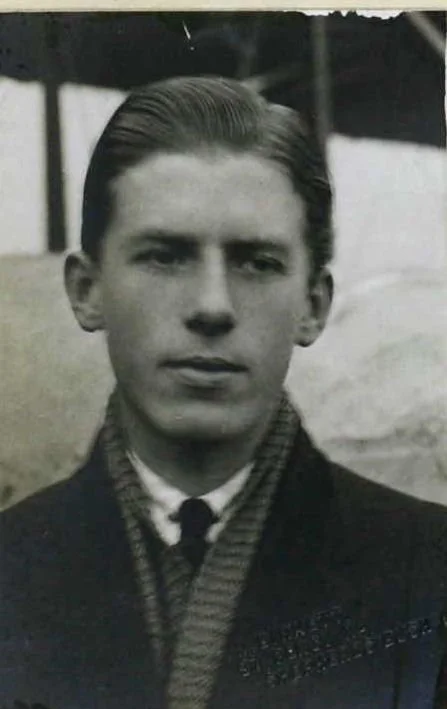
Beauchamp Wainwright joined the Royal Flying Corps in 1916 and flew over the Western Front.
He is the man who inspired me to write obituaries. I nursed him in 1987 when I was a very young student nurse and he was a man approaching death. His stories about a life I could only imagine helped me to realise the value of the stories our elders have to share - if only we were listening. I have written his obituary, based on an interview I found (and purchased) and on research that includes Ancestry.
His recently written obituary is below.
With the ground quickly approaching, 2nd Lieutenant Beauchamp Wainwright was left with no option but to crash land his lightweight fighter plane behind German lines. And although his time as a Royal Flying Corps WW1 fighter pilot ended with his subsequent capture, it no doubt also saved his life. Not only was flying in its infancy but during the war’s most active campaigns, a fighter pilot’s average life expectancy was as little as six weeks.
Wainwright, who died in Sydney on 30 July 1987 aged 91, was lucky. He not only managed to land his machine safely, he avoided the enemy fire that damaged his windscreen and killed his engine. But upon extracting himself from his tiny cockpit, he found he was unable to budge the handle that would set his wood and fabric aircraft alight, thus preventing the enemy from learning Britain’s aviation secrets.
“Fortunately, one of the German aircraft (LVGs) had landed not far away and the crew came over to me,” he recalled. “One of them said to me, ‘if we didn’t come to look after you, you would have had a pretty rough time because you are not popular with the troops’.”
It was 28 August 1916, and Wainwright was flying with the RFC’s No. 60 Squadron, piloting a Morane-Saulnier N ‘Bullet’, a notoriously difficult machine to fly due to its design, his number 173 emblazoned on the tail. He was on an offensive patrol in the Bapaume-Peronne region on the Western Front, one of three ‘Bullet’ pilots escorting bombers of the No. 8 Squadron. Alongside him flew the British ace Albert Ball.
As the bombers were returning from their mission, Wainwright spotted six German LVGs climbing to intercept them. Diving out of the evening sun to attack the rear two enemy planes, he managed to drive one away but was unable to catch the other. He decided he would hedge-hop back to join his patrol but was surprised from behind by two of the LVGs, their machine guns blazing.
Wainwright spent the next three years a prisoner of war in various camps across Germany, initially at Cambrai fortress, then Osnabruck and Clausthal in the Harz Mountains. At Ströhen camp he was almost smothered in a tunnel and while at a camp near Coburg, he and another prisoner attempted an escape through the fence, but he got caught in the wire and was recaptured spending 10 weeks in solitary confinement in Basel fortress.
Beauchamp Mervyn Wright was born on 1 October 1895 in Reigate, Surrey, the only son and second child of Beauchamp, a merchant, and Florence. His older sister Vera became a well-known artist and poet. Early in her pregnancy, Florence, together with Vera, accompanied her husband on the sea voyage to Western Australia to oversee the family’s shipping and importing business in Geraldton. However, one month after arriving, Beauchamp Snr. died of pneumonia, leaving his pregnant widow and young child to return to England alone.
Her husband left Florence financially well off and the family shared their home in Surrey with a parlourmaid, cook and housemaid. Florence eventually remarried when Beauchamp was 10, around the same time as he became a boarder at Beaumont College, a prestigious Catholic public school in Old Windsor.
Wainwright recalled the announcement of war on the Bank Holiday in August 1914 as the last time he ever played cricket. He had planned to attend Cambridge University but was able to persuade his mother that he would be safer in the air than on the ground. He enrolled in the Beatty School of Flying at Hendon two months later although admitted that not much flying was done.
Disillusioned, Wainwright tried to join firstly the Royal Naval Air Service and then the RFC but was turned down each time due to colour blindness. Desperate to serve, like so many young men at the time, Wainwright joined the 16th Battalion of the Middlesex Regiment as a Private. He served with them until September 1915 when he fell onto muddy duckboards in a trench during training injuring his knee so badly that he was hospitalised. By the time he returned to the regiment a month later, they had shipped to France without him.
Determined to follow his dream to fly, he continued his lessons although on the day of his flying exam, his best friend was killed before his eyes while doing his first solo flight. Once qualified, Wainwright reapplied to the RFC and was accepted. It is likely that by March 1916, with the war well underway, airmen, even colour-blind ones, were too valuable to turn away.
Wainwright trained on several early aircraft, from Maurice Farman Shorthorns and Longhorns at Northolt to BE2Cs, BE2Ds and Avros at Croydon, always pushing the limits of his machine with stunts like a loop the loop.
“I had a cushion on my seat because I wasn’t very tall and when I landed it wasn’t there anymore!” he recalled after one such incident. “[My instructor] asked me what had happened to it but all I could say was ‘how would I know?’”
Risk was a daily occurrence that Wainwright cheerfully accepted, calling it “a bit of a ragtime show”. He recalled one “exciting” incident over Arras where, upon seeing Ball being tailed by the enemy, decided to go help but got into a spin.
“I thought my tail had been blown off,” he said. “None of the controls worked at all, the joystick was loose and I had no idea what to do!”
It seems that luck shadowed Wainwright throughout his life. Following his repatriation as a POW in January 1919, Wainwright never flew again. He became a farmer and in 1922, married Bessie Hazlewood, migrating with her to Sydney. Their daughter Devia, known as April, was born there in 1923.
Ironically, given his colour blindness, Wainwright became an optometrist, initially working in Newcastle. His first marriage ended in the late 1930s and in approximately 1943, he married Lilian Hadley, known as Molly. During the 1960s, he and Molly moved to Collaroy Plateau. Molly died in 1977.
He is survived by his daughter April and her family.
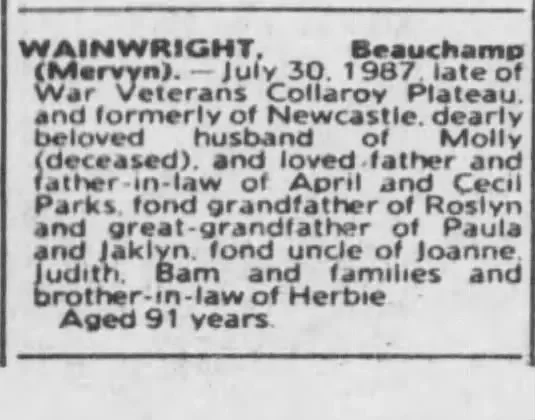
The alternative ‘obituary’, from the Sydney Morning Herald.